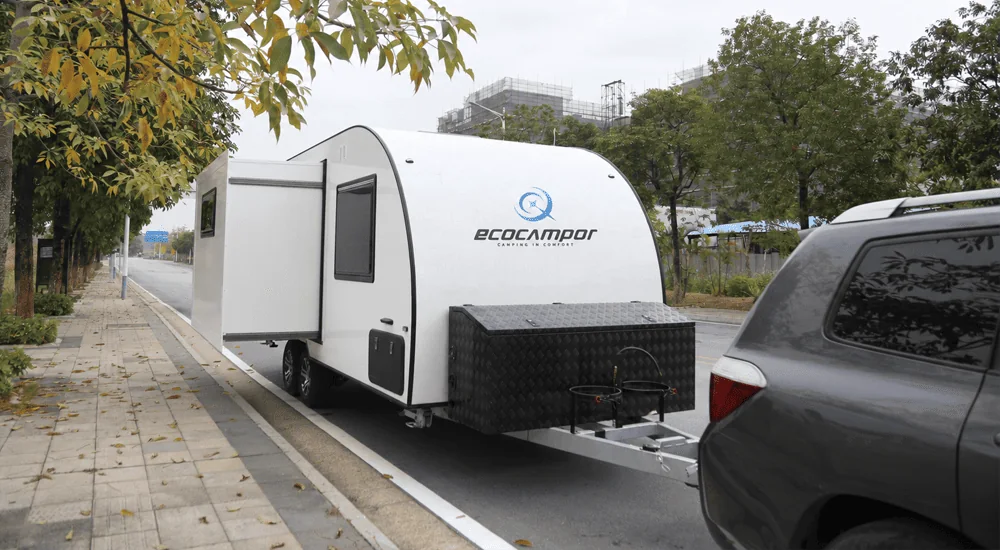
How to match a tow vehicle to a caravan: compare far more than the vehicle’s advertised braked towing capacity. A safe, workable combination must remain within the loaded caravan’s ATM, the tow vehicle’s GVM, the combination’s GCM, axle and tyre limits, and the rated capacity of the towbar and coupling.
Key Takeaways
- A caravan being below the vehicle’s advertised towing capacity does not automatically make the combination suitable.
- Check GVM, GCM, ATM, GTM, axle limits, tyre limits, towbar capacity, coupling capacity and actual tow-ball mass together.
- Tow-ball mass is carried by the vehicle and uses part of its available payload.
- Water, batteries, food, passengers, accessories and outdoor equipment can materially change real travel weights.
- Use a public weighbridge after the vehicle and caravan are loaded as they will actually travel.
How to Match a Tow Vehicle to a Caravan: Start With All Limits
Australian towing questions often start with one number: “Can my vehicle tow 3,000 kg?” That is only the beginning. Passengers, bull bars, canopies, long-range tanks, fridges, recovery gear, water, batteries, food and tow-ball mass all affect the result.
The Queensland Government advises that safe towing starts with a suitable tow vehicle and trailer combination, and that owners should consider passengers, vehicle equipment, vehicle modifications and the caravan’s water, gas, food and other contents. If the real combined mass is uncertain, use a public weighbridge.
The Seven Numbers to Check
| Term | Plain-English meaning | Why it matters |
|---|---|---|
| Vehicle kerb or tare mass | The vehicle’s stated reference unladen mass under the manufacturer’s conditions. | It is the starting point for estimating payload, but definitions and included equipment can vary. |
| GVM | Gross Vehicle Mass: the maximum permitted loaded mass of the tow vehicle. | It includes people, accessories, cargo and the tow-ball load imposed on the vehicle. |
| GCM | Gross Combination Mass: the maximum permitted loaded mass of the coupled vehicle and caravan combination. | It can prevent a vehicle from using full GVM and full advertised towing capacity at the same time. |
| Braked towing capacity | The maximum trailer mass the vehicle is rated to tow when the required trailer brakes are fitted. | It is a limit, not proof that payload, axle, towbar and GCM checks will pass. |
| Caravan tare mass | The caravan’s stated reference mass in its specified unladen condition. | It is not the mass of a holiday-ready caravan with water, food, batteries and equipment. |
| ATM | Aggregate Trailer Mass: the maximum loaded caravan mass when unhitched, including the coupling load. | The loaded caravan must not exceed its ATM. |
| GTM | Gross Trailer Mass: the maximum mass carried through the caravan tyres and axles when hitched. | It excludes the portion of mass carried through the coupling onto the tow vehicle. |
Transport WA explains that ATM includes the tow-hitch download and is the sum of GTM plus tow-hitch download. Its guidance also notes that a vehicle’s GCM may be lower than the sum of its GVM and towing capacity. Read the current Transport WA GVM and GCM guidance before relying on any calculation.
Why Maximum Towing Capacity Is Not Enough
A vehicle may have 3,000 kg of advertised braked towing capacity, but only a modest amount of payload left after the family, accessories and travel gear are loaded. Tow-ball mass is then imposed through the coupling onto the vehicle, consuming more available payload and potentially loading the rear axle heavily.
Use this order when assessing a potential combination:
- Identify the exact vehicle variant, year, drivetrain and specification.
- Record its GVM, GCM, braked towing capacity, maximum tow-ball load and axle limits from official documentation.
- Check the towbar and coupling ratings. The lowest applicable rating controls.
- Build a realistic vehicle load: passengers, accessories, tools, fridge, luggage and the actual tow-ball mass.
- Build a realistic caravan load: water, gas, food, bedding, batteries, solar equipment and outdoor gear.
- Check GVM, GCM, ATM, GTM, axle, tyre, towbar and coupling limits separately.
- Weigh the completed combination in its real travel condition.
What Tow-Ball Mass Changes
Tow-ball mass is the downward load the caravan imposes through the coupling. It is part of the caravan’s ATM, but it is also carried by the tow vehicle. In practical terms, it affects vehicle payload and axle loading.
Do not treat tow-ball mass as a fixed number for every trip. It can change as water, food, bicycles, generators, storage boxes and other equipment are added or moved. The correct figure is the measured figure for the actual loaded caravan.
Worked Example: Check One Complete Combination
The figures below are hypothetical. They are included to show the process only and must not be reused as ratings for another vehicle or caravan.
Vehicle ratings
- Reference kerb mass: 2,250 kg
- GVM: 3,100 kg
- GCM: 6,000 kg
- Maximum braked towing capacity: 3,000 kg
- Maximum tow-ball load: 300 kg
Caravan ratings
- Stated tare mass: 2,200 kg
- ATM: 2,800 kg
- GTM: 2,540 kg
Step 1: Calculate the vehicle payload allowance
This allowance must absorb every item not already included in the manufacturer’s stated reference mass.
| Vehicle load | Mass |
|---|---|
| Two adults and two children | 250 kg |
| Bull bar, canopy and other accessories not included in the reference mass | 120 kg |
| Fridge, tools and luggage | 90 kg |
| Actual loaded tow-ball mass | 260 kg |
| Total added vehicle load | 720 kg |
The vehicle appears to be under GVM in this planning example. That alone does not confirm the combination is suitable: front and rear axle loads must still be checked by correct weighing.
Step 2: Calculate the caravan’s travel mass
| Caravan load | Mass |
|---|---|
| Water | 160 kg |
| Gas and usable contents above the stated tare condition | 35 kg |
| Food, clothing and kitchen equipment | 120 kg |
| Battery, solar and other accessories added after tare measurement | 75 kg |
| Outdoor equipment | 60 kg |
| Total added caravan load | 450 kg |
Step 3: Check towing capacity and GCM
For a conceptual GCM check, avoid counting tow-ball mass twice. The loaded vehicle mass already includes the 260 kg transferred through the coupling, while the caravan’s ATM also includes it.
This hypothetical combination passes the simplified calculations. It is still not approved until real scale weights, axle loads, tyre ratings, towbar and coupling limits have also been checked.
Pre-Purchase Caravan and Tow Vehicle Checklist
- Record the exact vehicle year, variant, drivetrain and option specification.
- Obtain official GVM, GCM, braked towing, tow-ball and axle ratings.
- Check the fitted towbar and coupling ratings.
- Record the caravan’s tare, ATM and GTM.
- Confirm what is included in the caravan’s advertised tare figure.
- Estimate passengers, permanent accessories and cargo carried in the vehicle.
- Estimate water, gas, batteries, food, clothing and outdoor equipment carried in the caravan.
- Model one realistic fully loaded trip, not a showroom scenario.
- Leave margin for inaccurate estimates and future accessories.
- Plan a travel-condition weigh after the combination is configured.
Hitching, Brakes and Road Setup
Weights are only one part of matching a combination. The vehicle needs a suitable towbar, coupling, electrical connection, braking arrangement and mirrors for the actual caravan being towed.
Before departure, verify:
- the coupling is fully engaged and positively locked
- safety chains are correctly attached
- the breakaway cable is correctly connected where required
- lights, indicators and electric brakes operate correctly
- tyres are in sound condition and set to appropriate pressures
- wheel fasteners and bearings have been checked in line with service instructions
- doors, hatches, awnings and loose equipment are secured
- mirrors provide the necessary rearward vision
For current NSW-specific towing, braking and breakaway-system requirements, review the NSW Government caravan towing guidance. Requirements can vary by jurisdiction and exact combination.
Load the Combination for Stability
Keep heavy items low, secure every item against travel forces and avoid concentrating excessive mass at either extreme of the caravan. Recheck measured tow-ball mass after significant loading changes, especially after adding water, batteries, generators, bicycles or external storage equipment.
The National Transport Commission’s Load Restraint Guide is a useful reference for safely restraining loads carried on vehicles and trailers.
Common First-Time Towing Mistakes
“The caravan is below the towing capacity, so it is safe.”
Not necessarily. GVM, GCM, payload, axle, tyre, towbar, coupling, ATM and GTM limits all still apply.
“The brochure tare is what I will tow.”
Tare is a reference condition. A real trip adds water, gas, food, bedding, batteries, accessories and personal equipment.
“Tow-ball mass belongs only to the caravan.”
The caravan creates the load, but the tow vehicle carries it through the coupling. It must be included in vehicle payload and axle checks.
“A suspension upgrade increases every rating.”
Do not assume this. A modification may affect one approved rating or handling characteristic while GCM, axle, towbar or other manufacturer limits remain unchanged. Transport WA states that increasing GVM does not automatically increase GCM.
“A little over is close enough.”
A rated limit is not a target. Reduce the load or select a more suitable vehicle-and-caravan combination before travel.
Frequently Asked Questions
Can my vehicle tow a caravan if the caravan ATM is below the braked towing capacity?
Possibly, but that is only the first check. Also verify the loaded vehicle GVM, GCM, actual tow-ball mass, axle and tyre limits, towbar and coupling ratings, and the caravan’s ATM and GTM.
Does tow-ball mass reduce vehicle payload?
Yes. The downward load imposed through the coupling is carried by the tow vehicle and must be included when checking its loaded mass and axle loads.
Should I use caravan tare or ATM when selecting a tow vehicle?
Use a realistic loaded travel mass for planning and ensure it remains within the caravan’s ATM. Tare is only a starting reference; ATM is a maximum rating, not a prediction of every trip.
Do I need a weight-distribution hitch?
That depends on the exact vehicle, caravan, towbar, hitch and manufacturer instructions. A weight-distribution hitch does not create extra payload and should not be used to compensate for poor loading.
When should I use a weighbridge?
Use a weighbridge after the vehicle and caravan are configured and loaded as they will travel, then reweigh after major changes. Ask a qualified specialist how the measured values apply to GVM, GCM, axle loads, GTM and ATM.
Choose the Combination, Then Verify It
The safest buying decision does not come from the largest number in a brochure. It comes from matching the exact tow vehicle and caravan as one loaded system, then confirming the travel-condition weights.
If you are comparing caravan categories, start with the expected trip, passenger count, water capacity, storage needs and towing vehicle—not only the floorplan. You can also explore Ecocampor travel trailer options and request model-specific information before narrowing a shortlist.