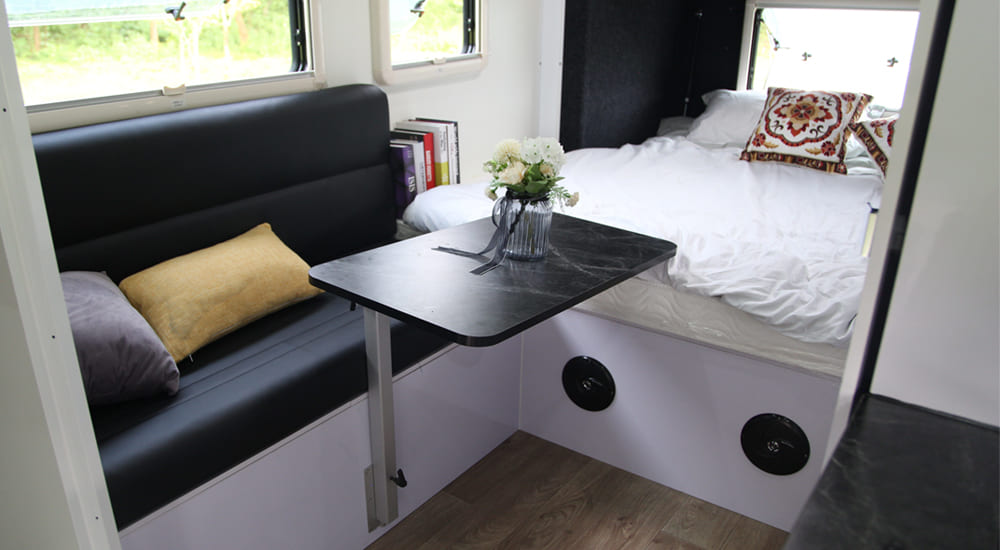
Fixed bed vs convertible dinette is one of the most important layout decisions in a small caravan. It changes how the whole van feels: should the bed stay ready all day, or should the dining area stay available without becoming a bed at night? There is no universal winner. The better choice depends on how often you travel, how much time you spend inside, who travels with you and what you want to do when the weather turns bad.
The short answer: choose a fixed bed if effortless sleep, a proper mattress and a simple end-of-day routine matter most. Choose a convertible dinette if daytime seating, indoor meals, work space or a more open small-caravan interior matter more. For many couples, a well-designed Murphy bed is the practical middle ground: a real bed that folds away without turning the main dinette into the nightly sleeping surface.
Key Takeaways
- A fixed bed removes a daily task and keeps bedding, mattress comfort and sleeping space ready at any time.
- A convertible dinette gives a compact caravan more useful daytime space, but only works well when the conversion is genuinely quick and comfortable.
- Rainy days, pets, remote work, indoor meals and longer trips usually increase the value of having both a ready bed and separate seating.
- A Murphy bed can be a strong compromise, but buyers should test how easily it lowers, where bedding goes and whether the dinette remains usable.
- Do not choose from a floor-plan drawing alone: walk through arrival, dinner, bedtime, storage access and a rainy morning before deciding.
Important: Layouts, bed dimensions, payload, storage access and standard equipment vary by model and market. Always confirm the exact specifications, floor plan and vehicle weights of the caravan you are considering before ordering or travelling.
Why This Choice Matters More in a Small Caravan
In a larger caravan, it may be possible to have a permanent queen bed, a generous dinette, a separate bathroom and plenty of storage. In a compact travel trailer, every square metre has to do more than one job. A bed occupies floor space all day; a dining area can become a bed at night; and a change in one zone can affect the kitchen, walkway, storage and bathroom access.
The real question is not simply “bed or dinette?” It is: which part of your routine should never need to be packed away?
| Daily situation | Usually favours | Why it matters |
|---|---|---|
| Long travel days, hiking or active touring | Fixed bed | You can arrive, wash up and sleep without moving cushions, tables or bedding. |
| Weekend trips with most meals outdoors | Either layout | If you rarely sit inside, a convertible space may be easy to live with. |
| Frequent rain, cold weather or indoor breakfasts | Fixed bed plus separate dinette | Indoor living becomes more important when you cannot use the campsite outside. |
| Working remotely from the caravan | Permanent dinette or dedicated table | A proper seated workspace is more useful than repeatedly rebuilding a bed. |
| Travelling with dogs or children | Separate sleeping and seating zones | It is easier to manage muddy paws, naps, meals and bedtime routines. |
| Wanting a compact van with flexible daytime space | Convertible dinette or Murphy bed | The sleeping area can make room for seating, dining or moving around. |
When a Fixed Bed Is the Better Long-Term Choice
A fixed bed is not just about avoiding a few minutes of setup. It changes the end of every travel day. After driving, setting up camp, cooking, showering or spending the day outside, many owners value being able to climb straight into a bed that is already made.
1. You travel often or stay away for longer periods
One night of converting a dinette may feel simple. Repeating that routine every evening and every morning for a multi-week trip can become tiring. A fixed bed removes the decision and the task. Bedding stays in place, the mattress stays flat and the sleeping zone remains ready for an early night, a nap or an unwell traveller.
2. Sleep quality is a priority
A permanent bed can usually use a more consistent mattress and support system than a dinette conversion. It may also avoid cushion gaps, uneven surfaces and the need to store bedding during the day. This matters especially for taller travellers, people with back or joint concerns, and anyone who knows that poor sleep affects the next day’s drive.
3. You usually eat and relax outdoors
For many touring couples, the campsite is the main living room. If you normally cook outside, eat under the awning and sit around a camp table, a large interior dinette may be less important than a ready-to-use bed. In that travel style, a small table, compact lounge or outdoor setup can be enough.
4. You travel with pets
Pets can make a clear separation between sleeping and eating areas valuable. A permanent bed can stay protected until the final evening walk, while the dinette remains available for meals, gear sorting or a rainy-day retreat. It can also reduce the amount of bedding that must be moved around when sand, dirt or wet gear enters the van.
When a Convertible Dinette Makes More Sense
A dinette-to-bed conversion is not automatically a compromise. In the right caravan and for the right travel pattern, it can make a small interior feel noticeably larger and more useful during the day.
1. You need daytime seating more than instant bedtime
If you regularly eat breakfast inside, work on a laptop, play cards, help children with schoolwork or spend wet afternoons in the caravan, a dinette has real value. A fixed bed may be comfortable at night but can leave the main living zone feeling limited during the day.
2. Most trips are short
For occasional weekends or overnight stops, a quick conversion may not be a burden. The key word is quick. If the table drops easily, cushions are clearly labelled, bedding has a dedicated place and the finished bed is comfortable, the routine can be entirely practical.
3. You want the smallest possible caravan without losing indoor flexibility
In a compact trailer, a convertible bed can free up space for a larger table, a more open walkway, extra storage or a more usable kitchen. This can suit buyers who prioritise a lighter, shorter or easier-to-store caravan but still want a place to sit inside.
Watch for the hidden trade-off: a convertible dinette only saves space if you are happy to convert it. Before buying, ask where the bedding goes, whether the cushions are comfortable, whether one person can make the bed alone and whether you can still access the fridge, toilet or storage while it is set up.
Is a Murphy Bed the Best Compromise?
A Murphy bed folds against a wall or over a lounge area, creating more daytime room while preserving a purpose-built bed and mattress. For many small-caravan buyers, it is the most balanced layout option—but only when the mechanism and surrounding space are well designed.
A good Murphy bed can offer a ready mattress, a separate dinette and a conversion that takes seconds rather than a full cushion rearrangement. However, it is still a moving component. Test it before you buy.
| Murphy-bed question | What to check in person |
|---|---|
| Can one person operate it? | Lift and lower the bed yourself. Do not rely only on a showroom demonstration. |
| Can bedding stay in place? | Check whether pillows, doona and sheets need to be removed each morning. |
| Is the mattress comfortable? | Ask about dimensions, thickness, support and whether an upgrade is possible. |
| What happens to the lounge? | Confirm whether cushions must be moved and whether the dinette remains practical. |
| Can you move around at night? | Open the bed and walk to the bathroom, door and fridge as you would when travelling. |
The Five-Minute Floor-Plan Test Before You Buy
Brochures and 3D plans are useful, but they do not reveal how a compact caravan feels during a real day. When visiting a dealer, use this simple test with everyone who will travel in the van.
- Arrive in the rain: imagine entering with wet shoes, jackets and groceries. Is there somewhere to sit, hang gear and move around without blocking the bed?
- Make dinner: open the fridge, use the bench area and check whether another person can pass through the van.
- Set up for sleep: convert the bed exactly as you would at a campsite. Time it. Move the cushions. Find the bedding storage.
- Use the bathroom at night: with the bed made, can both travellers safely reach the bathroom and door?
- Try a wet morning: picture two people sitting inside for several hours. Is there enough seating, bench space, ventilation and personal room?
This same practical thinking should also be used for storage and towing. A compact van can be easy to tow, but it still needs enough real-world space for food, bedding, water, outdoor equipment and passengers. Before selecting a model, read our guide on how to match a tow vehicle to a caravan.
Do Not Forget Storage and Weight
Layout decisions affect what you carry and where it lives. A fixed bed may provide useful under-bed storage, while a convertible dinette may use the same area for seat bases, table hardware or bedding during the day. Neither is automatically better; access matters as much as volume.
Think through the items you use every day: shoes, jackets, chargers, pet gear, towels, pantry food, outdoor chairs and recovery equipment. Wet or dirty equipment should not end up on the bed or dining cushions. For practical ideas, see our guide to caravan exterior storage for wet gear.
Remember that every added accessory and every item loaded into the caravan affects real travelling weight. Confirm payload, ball weight, axle limits and the towing limits of the actual tow vehicle—not just the caravan’s advertised dry weight.
Fixed Bed vs Convertible Dinette: A Simple Decision Guide
| If this sounds like you… | Start by looking at… |
|---|---|
| “After a big day outside, I want to go straight to bed.” | Fixed bed |
| “We eat outside most of the time and only need a compact van.” | Fixed bed with a smaller lounge, or a simple convertible layout |
| “We expect rainy days, indoor meals or laptop work.” | Fixed bed plus separate dinette, or a well-designed Murphy bed |
| “We only travel on weekends and want the most living space possible.” | Convertible dinette or Murphy bed |
| “We travel with pets, children or guests.” | Separate sleep and seating zones where possible |
| “We do not want to move cushions every single day.” | Fixed bed or Murphy bed |
Frequently Asked Questions
Is a fixed bed always better in a small caravan?
No. A fixed bed is often better for long trips and easy bedtime routines, but it can take valuable daytime floor space. If you use the caravan mainly for short trips and spend a lot of time inside during the day, a convertible dinette may be the more useful choice.
Is a convertible dinette comfortable enough for daily use?
It can be, but comfort depends on the mattress or cushions, support base, gaps, bed dimensions and setup process. Test the conversion yourself and lie on the finished bed before making a decision.
Should I choose a Murphy bed or a dinette conversion?
A Murphy bed is usually preferable when you want a purpose-built mattress and a quicker transition between day and night. A dinette conversion can provide more flexibility in a very compact layout, but it often requires more cushion and table movement.
Does a fixed bed mean less storage?
Not necessarily. Some fixed beds have generous under-bed storage, while some dinette bases provide useful compartments. Compare access, not just claimed storage volume, and consider where bedding and everyday items will go.
Final Thought: Choose the Routine You Want to Keep
The best small caravan layout is the one that removes friction from the part of travel you value most. If your ideal trip ends with an immediate, comfortable sleep, protect the bed. If your ideal trip includes long indoor breakfasts, work sessions or rainy-day games, protect the dinette. And if you need both, put a well-designed Murphy-bed layout high on your shortlist.
Owner discussions consistently show that people regret a layout less when they choose it around their actual travel behaviour—not around a brochure image. A useful starting point is the real-world owner conversation that inspired this guide, alongside established Australian caravan-layout advice from Jayco Australia.
Planning Your Next Caravan Layout?
Start with how you travel: trip length, sleeping routine, indoor time, storage needs and tow vehicle capacity. A practical floor plan should work at bedtime, in the rain and on travel day—not only in a showroom.